Padel
How to Handle Sweaty Padel Kit Without Running a Wash Every Day
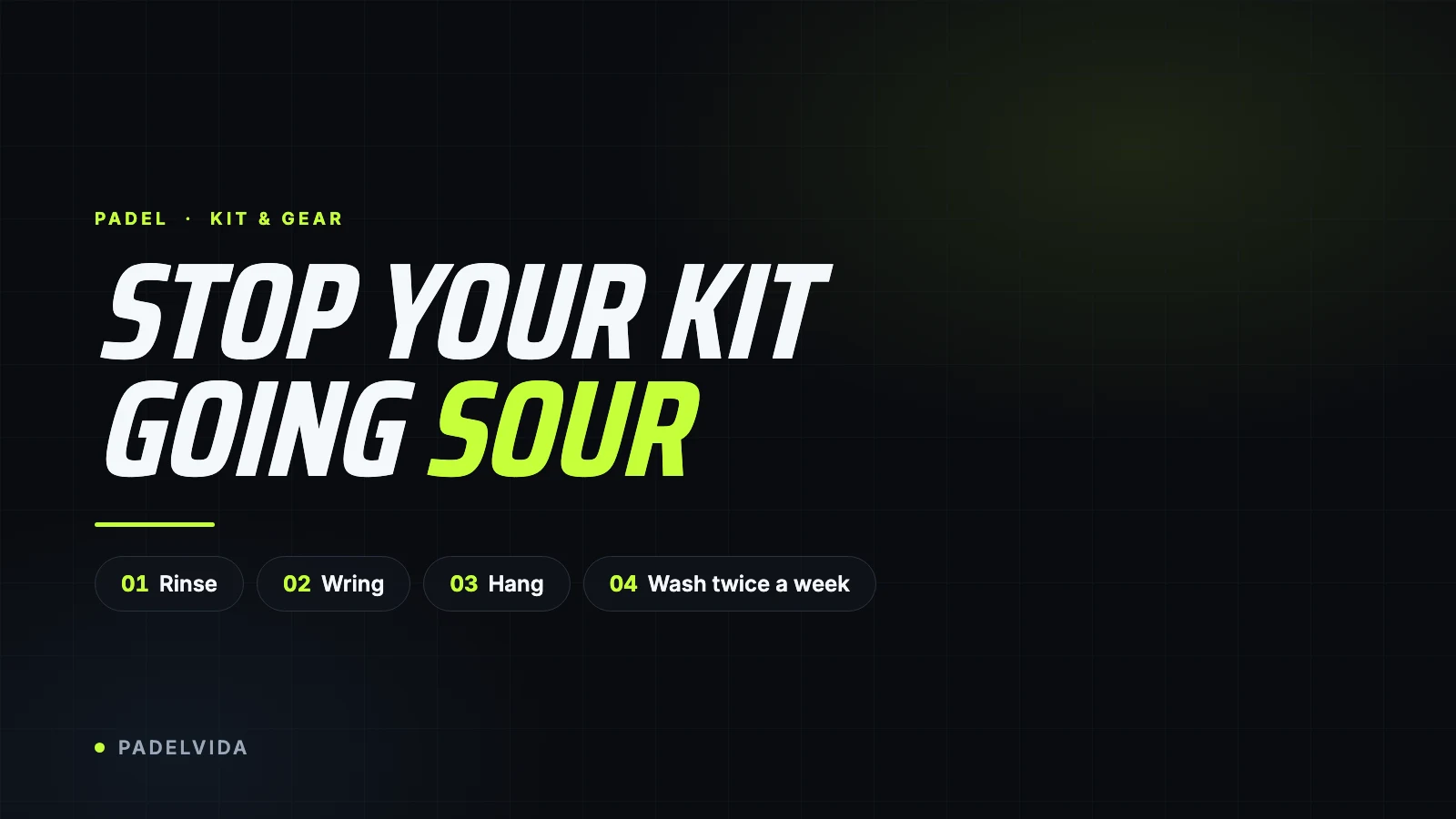
Play four or five times a week and every session produces a soaked set of kit. Running the machine daily to keep up is wasteful and wears the clothes out fast. Wash less often and synthetic kit turns permanently sour, so a shirt that came out of the wash clean stinks again ten minutes into the warm-up.
Both problems have the same fix, and most of it happens in the two minutes after you come off court.
Why synthetic kit goes permanently bad
Polyester is hydrophobic and oleophilic. It repels water and grabs onto oils. The sebum from your skin and the odor compounds in sweat soak into the fiber itself instead of sitting on the surface where detergent can reach them. A short cycle at 30 degrees cleans the surface and leaves the oils where they are, and every session adds a little more.
Once those oils are deep in the fiber, warmth and moisture reactivate the smell. That’s why the shirt is fine in the wardrobe and unbearable by the second game.
Cotton doesn’t behave this way, because it absorbs water and gives up oils readily. The bacteria differ too: polyester selectively hosts Micrococcus species, which are efficient at converting sweat components into the sulfurous compounds and short-chain fatty acids that smell bad.
What accelerates all of it is damp storage. A wet shirt rolled into a closed bag for eight hours does more damage than the session itself.
The two minutes that matter most
Get the kit wet and dry again as fast as you can.
The easiest version: drop everything on the shower floor and rinse it while you wash yourself. Plain water is enough, since the point isn’t cleaning, it’s flushing out salt and sweat and stopping the bacteria bloom that happens in a damp bag.
Then wring it out properly, harder than feels necessary. That step decides whether the kit dries in two hours or eight. Twist synthetics; press merino instead, because wringing damages the fibers.
Hang it spread out with air reaching both sides, not folded over a rail where the fold stays wet for hours. If you live somewhere humid, point a fan at the rack or leave a window open.
The way this goes wrong is leaving rinsed kit in a heap on the shower floor or back in the bag. An hour won’t hurt anything, but overnight or a full working day in a closed bag is worse than not rinsing at all. Hang it before you leave the bathroom.
Socks and grips get the same treatment. Shoes come out of the bag and get opened up to air, not rinsed.
Own enough kit to wash a full load twice a week
The boring answer solves the original problem. Six or seven sets of shirts, shorts, socks and underwear lets you wait for a genuinely full load twice a week instead of running a half-empty machine every night, and kit is cheap next to the electricity, water and wear you save.
Socks and underwear are the worst offenders and the first thing you run out of, so buy more of those than shirts.
Wash settings for synthetics
Forty degrees beats thirty. Sebum doesn’t dissolve properly at thirty, and that invisible buildup over months is what eventually ruins the shirt.
Use roughly half the detergent you’d use for a cotton load. Synthetics hold detergent residue, and residue gives bacteria something to feed on.
Skip fabric softener entirely. It coats the fibers and makes technical fabric worse at moving sweat.
Turn on an extra rinse if the machine has one.
Rescuing kit that already smells
Soak it for a few hours in warm water with oxygen bleach, sold as sodium percarbonate or under names like Vanish Oxi, then wash it normally. That soak pulls the accumulated oils back out of the fiber.
A white vinegar soak also helps, but run it as a separate soak rather than mixing the two.
Kit that has spent a year going into a closed bag wet sometimes never fully recovers.
Is cotton the answer?
No. It solves the smell and creates worse problems: it soaks up sweat, gets heavy, stays wet for the whole session and chafes once it’s wet. For a fast lateral sport in a warm climate that’s a real performance and skin cost, and the smell problem is solvable without giving any of that up.
What merino does and doesn’t solve
Merino wool resists odor better than any synthetic, which is why brands like Icebreaker built their reputation on it. It performs when wet, and it stays fresh across two or three wears where polyester wouldn’t.
That’s a short-term property. It doesn’t protect against long-term buildup, and heavy daily sweating is exactly the case that defeats it.
Merino is also harder to rescue than polyester, because of how you’re forced to wash it. Wool is a protein fiber, so hot washes shrink and degrade it, and oxygen bleach is alkaline enough to damage it. The two tools that strip accumulated sebum are both off the table, which leaves you washing cool and gentle, and that’s the regime that lets sebum accumulate in the first place.
Two other things make it worse. Biological detergents contain protease, an enzyme that digests protein and therefore digests wool, so ordinary detergent is slowly eating the garment. And if the garment is a merino and nylon blend, as many durable ones are, the nylon fraction holds odor the way polyester does no matter how the wool behaves.
If you do wear merino: air it fully after every wear, wash on the wool cycle at thirty with a proper wool wash, and give it an occasional lukewarm soak with a splash of white vinegar.
Where merino earns its price is travel and cooler conditions, and any situation where you can’t wash between wears. For daily play in heat, cheap synthetics plus the drying routine beat it on drying speed, durability and cost.
Two smaller notes on fabric. Nylon holds less odor than polyester in most comparisons, so a nylon-heavy shirt tends to age better, though it’s a mild edge rather than a fix. And silver-ion antimicrobial treatments work at first and fade over dozens of washes, so they’re not worth a premium.
Shoes: the insole is where the smell lives
Shoe odor comes mostly from the insole rather than the upper, so start there. Pull the insoles out after every session and let them dry separately, and wash just the insoles every week or two. That handles most of the odor and it’s far less destructive than putting the whole shoe through a machine.
If you do wash the shoes, once a month is plenty. Cold water, gentle cycle, laces and insoles removed, shoes inside a pillowcase or mesh bag. Never tumble dry them and never leave them on a radiator.
Drying shoes: paper, and out of the sun
Stuffing shoes with crumpled newspaper or plain kitchen paper does two jobs. It wicks moisture out of the inside, where air barely circulates, and it holds the shape while the upper dries so the toe box doesn’t curl inward and stiffen. Change the paper once it’s saturated, usually after an hour or two, otherwise you’ve parked a wet sponge inside the shoe. On white or light shoes use plain paper, since wet newsprint transfers ink.
Dry them in the shade. Heat matters more than UV here: direct sun gets the inside of a shoe far hotter than the surrounding air, and that heat softens the adhesives holding the sole to the upper, which is the most common reason soles start peeling. Radiators, heated floors and parked cars do the same thing.
If you want them dry faster, point a fan at them or use one of the cheap low-heat shoe dryers. Airflow gets the job done without cooking the glue.
Custom orthotics need different handling
If you wear custom insoles, don’t put them in the machine and don’t soak them. They’re typically a molded shell with a bonded top cover, and water plus heat delaminates the cover and can deform the shell. That’s an expensive thing to ruin over a smell.
Wipe them with a damp cloth and a little mild soap, then wipe with diluted white vinegar or isopropyl alcohol to kill what’s causing the odor, and let them air dry away from any heat source. Take them out of the shoes after every session so both dry properly.
Two things worth asking your podiatrist if you play most days. A duplicate pair is usually much cheaper than the original once they have your scan or cast on file, and it lets you run two pairs of shoes without moving orthotics across daily. And the top cover is replaceable, so ask what a recover costs, since it holds the odor and wears out before the shell does.
Why two pairs of shoes is worth it
The midsole is the foam layer between the outsole and your foot, usually EVA, and it compresses two ways. Temporarily, because the foam is viscoelastic and takes hours to return to full thickness, and permanently, where the cell walls collapse and never come back. The second kind is why an old pair feels flat and dead while still looking fine.
Rotation builds on the first: give a pair a day off and it starts the next session near full thickness rather than already partly flat.
Being straight about the evidence, the widely repeated “24 hours to recover” figure is a rule of thumb rather than a measured constant, and it varies by foam and by how hard you loaded it. Evidence that rotation extends total midsole life measured in hours of play is thinner than people imply. What’s better supported is a different benefit. A study in the Scandinavian Journal of Medicine and Science in Sports followed 264 recreational runners for 22 weeks and found a 39% lower injury rate among those who rotated between several pairs, most likely because varying the shoe varies how load travels through the foot and leg.
There’s also a padel-specific wrinkle. On these courts the outsole usually wears out before the midsole does, because sand and lateral sliding grind the tread away quickly. So for padel the strongest arguments for a second pair are the drying time and the load variation rather than foam longevity. If you’re wondering whether your current pair is done, we covered the signals in knowing when to replace your padel shoes.
The short version
Rinse the kit in the shower, wring it hard, hang it with airflow, and never let it sit wet in a bag. Own six or seven sets so you can wash full loads twice a week at forty degrees with half the detergent and no softener. Soak anything that already smells in oxygen bleach. Pull the insoles after every session, rotate two pairs of shoes, stuff them with paper and dry them out of the sun.
None of it takes more than a couple of minutes a day.